How to name your startup. A step-by-step guide
A comprehensive step-by-step guide for startup founders on how to name a business. Learn about the 12-point evaluation criteria, how to write a naming brief, and why you should ignore the .com obsession.
Article Summary
In this article you will learn
• That your brand name is the element of your brand with the most longevity, enduring far longer than logo updates or website refreshes.
• How to write a structured naming brief to clearly define what you are naming, who it is for, and the core ideas you want to convey.
• The crucial rule to never let an unavailable .com domain bully you into settling for a weak name, and how to use modern Top Level Domains (TLDs) instead,.
• How to use a rigorous 12-point criteria checklist to objectively score names on inventive, strategic, and cultural qualities before performing technical checks.
Added on:
Updated on:
File under:
Written by:
Choosing a brand name: Why should you make the effort?
If you’re reading this article, I’m assuming you’ve got an interest in brand names and are keen to make a memorable and positive impression with your brand.
You know you need to stand out, you want to be remembered for the right reasons, and you understand that a good first impression matters. That journey starts with your brand name. Long before anyone sees your logo, your website, or your social posts, they encounter the name. It is the first signal you send to the market, and it carries more weight and more longevity than most founders realise.
A brand name isn’t a throwaway decision or a placeholder to be “fixed later”. It works in partnership with your brand identity to shape perception, build trust, and set expectations from day one. Get it right, and every future branding decision becomes easier. Get it wrong, and you risk time, money, redesigns and damaged perceptions.
This article lays out a clear, structured approach to brand naming, designed specifically for startup founders with no prior naming experience, who want to avoid mediocrity and build a brand with intent from the outset.
Brand names influence positive brand perceptions from the very first encounter.
Language is a powerful tool, and as a brand namer and identity designer, I’m of the opinion that a brand name should be considered carefully. It will work as an equal partner alongside your brand identity design to create a positive first impression about your brand.
It is the first piece of information a person will learn about your company and, incidentally, is the element of your brand identity with the most longevity. So, if you’re a startup founder with a vision for your business, and you understand that in a world of brand noise and ever-increasing competition you need to stand out, you’ll want to spend some time getting your brand name right.
A brand name isn’t a throwaway decision or a placeholder to be “fixed later”. It works in partnership with your brand identity to shape perception, build trust, and set expectations from day one.
Ignore marketing ‘experts’ who insist that a name ‘isn’t important’ or that you can ‘revisit it later’. That is an extremely pointless exercise of doing the same work twice, spending double the money on brand identity, and having to undo potentially damaging perceptions because you couldn't be bothered to put effort into the name in the first place.
This article will show you a detailed, step-by-step approach to brand naming, so you can develop a brand identity on the foundation of a distinctive and memorable brand name. Don't rush into mediocracy.
1. Memorability and First Impressions: Why Naming Matters
You have a vision for your brand, you want it to look and sound good, and you want to engineer positive perceptions around it.
Your brand needs to be distinctive, persuasive, and the obvious choice when your customers are weighing the options.
Fundamentally, what are we looking for in an effective brand name?
The First Handshake
Your brand name is the starting point of your brand’s story. It is the first handshake you offer a potential customer. Before they see your logo or browse your website, they usually hear or read the name. If that name is bland, undifferentiated, or hard to say, you have already placed a barrier between you and your audience.
Cognitive Ease
A brand name should be easy to say, spell, and remember. These three cornerstones will stop your brand name from falling at the first hurdle.
If people can say it, they are more likely to remember it.
If they can't spell it, or it has an odd pronunciation, it’ll likely be forgotten.
Take the example of the marketing website "Desygner." This is a name that will constantly have to be spelt out to customers. You can imagine the conversation:
"Oh, I went to designer.com…"
“no, it's actually spelt d-e-s-y-g-n-e-r."
"Oh, so you say it like Des-why-g-ner?"
"No, you say it like ‘designer'."
Desygner has been renamed to Fleur.
The Retention Factor
Because the name is the brand element most frequently remembered by audiences, its memorability is paramount. While your visual identity might evolve—think of how the Kellogg's logo has subtly changed over 120 years—the name has remained constant.
You don’t want to rename your brand unless you really really have to. Avoid the unnecessary cost, effort, and the PR exercises. Take the time to develop a memorable name first time around.
2. Interesting Brand Names Lead to Interesting Identities
At The Identity Bureau, I hold a fundamental belief: Interesting brand names lead to interesting brand identities.
The Creative Foundation
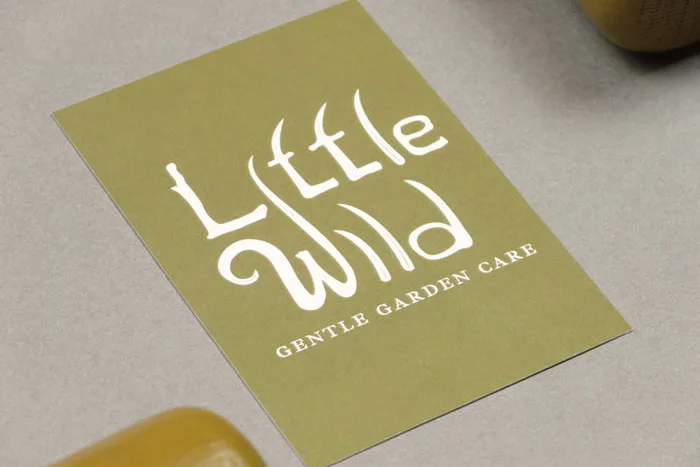
A name is a vessel to shape and carry your brand. If you choose a name that is evocative and full of character, you provide a stronger foundation for developing a memorable brand identity system. Consider the gardening company I named, ‘Little Wild’. The founder, Nikki Mason, had a holistic approach to gardening and a love for rewilding urban environments. The name ‘Little Wild’ stood out in an industry dominated by "men with mowers" and unimaginative, descriptive names. Crucially, the name lent itself to visual imagery. For the logo, we removed the letter ‘i’ in ‘Little’, allowing the ‘W’ in ‘Wild’ to grow up into that space. That visual wit was only possible because of the name.
The Problem with the Mundane
Conversely, initialisms, acronyms, and founder-based names often lack creativity. They fail to suggest positive qualities or create strong perceptions.
Take the example of US accountancy firm Beers, Hamerman, Cohen & Burger, PC (shortened to BHC&B).
Is it memorable? No. Will you remember it in two days' time? I doubt it.
Founder-based names absolutely lack imagination and do not convey meaning, personality, or ideas. When you settle for the mundane, you force your visual identity to do all the heavy lifting, which is a wasted opportunity.
3. Naming: Your First Step Towards a Distinctive Brand
In an era of endless choice and "copycat branding," a distinctive brand is a competitive advantage, not a luxury.
Controlling the Narrative
If a founder does not shape how their brand is perceived, competitors will inevitably do it for them. To put this another way, if you settle for brand mediocracy, and your competitor strives for greatness, then they’ve put you in the corner.
And thats compeition for you.
By making a decision to develop a brand name that is considered and distinctive, you strengthen every decision that follows.
Standing Out from the Noise
The ultimate goal is to be seen and remembered among the unremarkable and allow your brand name to be a distinctive brand asset. This is especially true for business who compete on a very similar level, or offer very similar services. Take, for example, a London-based pest control company ‘Pest Stop Boys’, as featured in my free guide to brand naming. An extremely distinctive brand name (not done by The Identity Bureau) that helps the company stand out from its competitors.
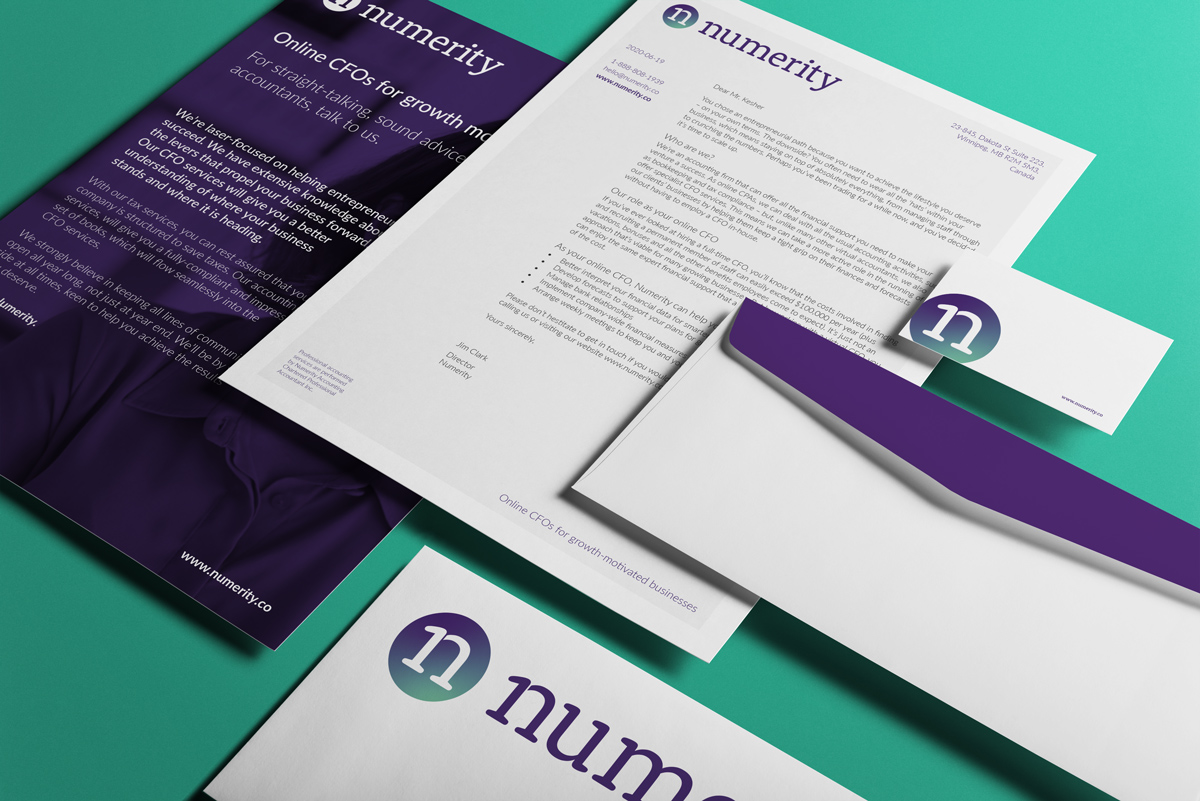
When we renamed Canadian accountancy firm from JCCPA to Numerity, this was the exact thinking we were going for. Founder Jim Clark wanted to leverage a distinctive brand name to set his firm apart from the competition, be memorable, and open the door to a more interesting brand identity design.
If a founder does not shape how their brand is perceived, competitors will inevitably do it for them; if you settle for brand mediocracy, and your competitor strives for greatness, then they’ve put you in the corner.
4. Forget About Domains (For Now…)
This is where I see most startup founders panic. You have a great idea, but you immediately check GoDaddy or Squarespace and the .com is taken.
Heed these words: Don’t worry about it.
The Domain Distraction
Do not start looking for a domain for your brand names at the start of the process. Why? Because if you search for domains before you pass through the quantitative and qualitative naming process, you will arrive at a name that you will ‘settle’ with just to satisfy your domain craving, and you’ll stop working through the creative ideas.
This is what we’d call ‘letting the tail wag the dog’.
No one cares if you have a .com or not. I’d even argue that a modern Top Level Domain (TLD - see below) can help position your firm as forward-thinking and contemporary.
Inventive Alternatives (TLDs)
The truth is, nearly all short, one-word, sensical .com domains are gone. But that doesn’t matter. There are hundreds of Top Level Domains (TLDs) that can make your company look super modern. Depending on your industry, you can use specific TLDs that add context and confidence to your brand:
• Architects: .archi or .studio.
• Accountants: .accountant
• Fashion: .clothing or .fashion.
• Technology: .tech, .cloud, or .app.
• Creative: .agency, .art, or .design.
These domains often look sharper and feel more intentional than a forced .com variation. And, of course, you’ll likely find an available domain that can accommodate the brilliant brand name you’ve allowed yourself to arrive at. have a look at Squarespace who offer over 300 TLDs.

Workarounds for the .com Obsession
Now, if you absolutely must have a .com (though you likely don't), there are creative workarounds:
• Prefixes: Add words like "weare," "get," or "the" (e.g., www.wearebrandname.com).
• Suffixes: Add "hq," "global," or "uk" (e.g., www.yournamehq.com).
• Hyphens: Use www.brand-name.com if necessary.
All said and done, checking for domain and social media availability is a technical quality check that should ONLY be completed toward the end of the process. If you choose brand names only through the filter of exact domain availability, you’ll kill creativity.
5. Getting Started: The Naming Brief
Before you begin generating name ideas, you must create a naming brief. This keeps you on the right track and ensures the name speaks to the right audience.
Alignment and Buy-in
It is very important that all decision-makers see, agree on, and sign off on the brief before any name generation begins. This document acts as your North Star, and will keep everyone on the same page. Later, when you come to presenting names, you can remind your attendees on the main points of the brief.
Defining the Scope and Audience
You need to be clear on exactly what is being named (product, service, or company) and, crucially, who it is for.
What are their common traits and demographics? Just as your future brand identity will be designed to cater to your audience, your name should also appeal to the people you are trying to attract.
It is very important that all decision-makers see, agree on, and sign off on the brief before any name generation begins. This document acts as your North Star, and will keep everyone on the same page.
6. Asking the Fundamental Question: What Should Your Brand Be Understood For?
This is the most important question in the brief. You need to identify the principles, beliefs, or values you want the name to convey.
Distilling Ideals and Concepts
Think about broad ideas or concepts you want your name to allude to and distill them into single words. For example, when the founders of Innocent Smoothies chose their name, they wanted to suggest purity, honesty, and a lack of "hidden nasties". That single word captures their entire brand essence.
Storytelling
A name should convey a personality, an idea, or a story behind the brand rather than just being a literal label. When I named the US CPA firm Kinline, the founder, Alex, wanted to honor the legacy of his late father, who was also an accountant. The themes of family, lineage, and history were pivotal. The name Kinline (Kin + Line) perfectly encapsulated that personal raison d'être, creating a brand he could lean into.
Another example of conceptual naming is the Nintendo Switch. The product name ‘Switch’ a;;udes core concept of the device: the ability to switch from a personal handheld device to a family gaming machine on a TV. A quick and easy way to ‘switch’ between the two, and the name was born.
Phonetics and Tonality
Consider how the name sounds. Do you want sharp vowels or soft sounds? Rhyming, onomatopoeia or alliteration?
Consider the soft-sounding name ‘Olay’, a skincare product. Consider floor mop brand ‘Swiffer’ and its use of onomatopoeia.
Food brand, especially sweets, often lean into alliteration and rhyming to aid memorability (Kit-Kat and Curly Wurly for example).
This use of sound symbolism can influence the perception of a brand name, and is a great tool to use to further reinforce the idea or concept you want your brand to be understood for. For further reading, see my article on sound symbolism here…

7. Approach and Construct: The Naming Axis
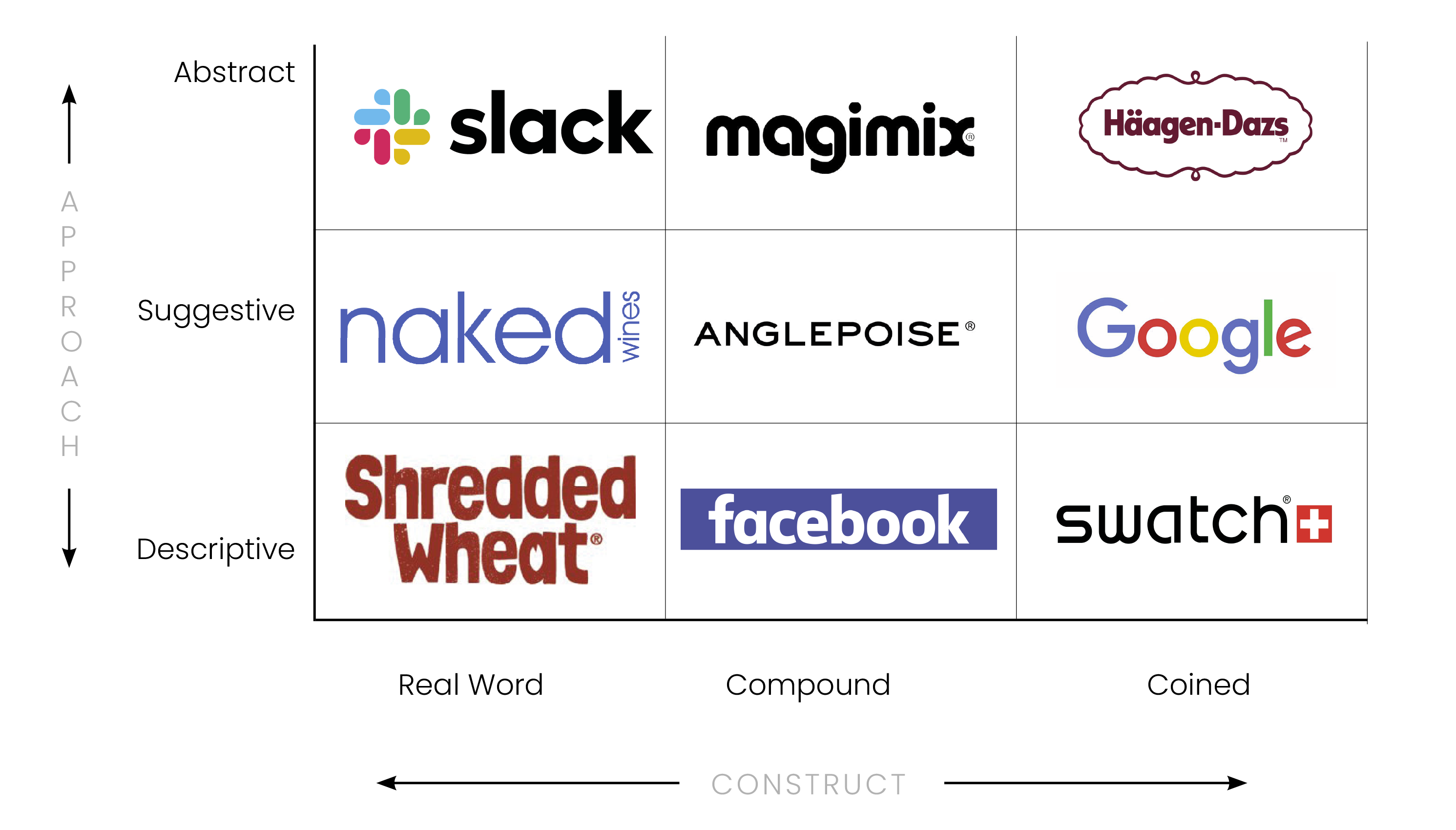
Before you begin generating brand name ideas, you can look at this framework that places names on an axis of Approach and Construct.
Although I would advise in letting your name ideas generate freely, this axis may be usefult o give you a steer toward the KIND of name you want, or the ind of name you want to avoid.
The Approach (Descriptive to Abstract)
• Descriptive: Literal names with zero ambiguity. Shredded Wheat is as descriptive as it comes—it is shredded, and it is wheat.
• Suggestive: These names allude to qualities or benefits without stating them outright. Naked Wines suggests organic or natural qualities. Anglepoise suggests the ability to position the angle of the light.
• Abstract: Real words used out of context, or entirely invented terms. Slack is a real word, but abstract for project management software.
The Construct (Real Word to Coined)
• Real Word: Existing vocabulary (e.g., Apple, Slack).
• Compound: Two words joined together. YouTube combines "You" and "Tube" (an old term for TV).
• Coined: Invented or "made-up" words. Häagen-Dazs is the ultimate coined name. It is completely meaningless, chosen simply because the founder thought it sounded upmarket and exotic.
Deciding where you want to sit on this axis early on can help focus your brainstorming efforts.
8. Generation: Striving for Quantity to Reach Quality
Now comes the fun part. To arrive at a quality brand name, you must go through quantity. That means you should allow yourself to write down many, many names. Hundreds if you can. This is the "No Bad Ideas" Phase, where anything goes. Keep your overall names and concepts in mind as you venture down the naming rabbit hole. Grab dictionaries, listicles, theasuruses and etymological dictionaries. Go on a literal word search, and remember, you need a long list of name ideas before you can have a shortlist of good names.
Name ideation exercises
These exercises aren’t about “coming up with a name” on the spot. They’re about creating raw material. Good names rarely appear fully formed; they’re usually uncovered by exploring ideas, language, and meaning first.
Word Maps
Start with the three or four ideas you want your brand to be understood for, that you wrote down in your naming brief.
Write one idea in the centre of a page and branch out freely:
• Synonyms
• Related concepts
• Emotional cues
• Visual associations
• Metaphors
For example, if one of your ideas is Clarity, you might branch into light, focus, signal, simplicity, direction, lens. Word maps are useful because they show you how far a single idea can stretch. Many strong names live one or two steps away from the obvious.
Now comes the fun part: Grab dictionaries, listicles, theasuruses and etymological dictionaries. Go on a literal word search, and remember, you need a long list of name ideas before you can have a shortlist of good names.
Laddering
Laddering helps you move up and down levels of meaning, rather than getting stuck on surface-level words.
Start with a simple descriptor, then:
• Ladder up to broader, more conceptual ideas
• Ladder down to more specific or tangible expressions
Example:
If your starting word is Modern
• Ladder up: Time → Era → Progress → Tomorrow
• Ladder down: Fresh → Clean → Streamlined → Advanced
Dictionaries
Standard dictionaries tell you what a word means now. Etymological dictionaries tell you what it used to mean, and the and that’s often where the interesting stuff is.
Look up:
• Word origins
• Older spellings
• Root words (Latin, Greek, Old English)
Etymological dictionaries can be a great source to help you find unexpected meanings or forgotten nuances of words.
Rhyming dictionaries can also be useful, not for rhymes as such, but for uncovering sound patterns and phonetic cousins you might not have considered.
Combine words
Once you’ve generated enough raw material, start experimenting with combinations.
This might include:
• Two real words combined
• A real word plus a shortened or adapted fragment
• A conceptual word paired with something more concrete
A Warning on Generators
Avoid online name generators. They do not understand your brief, your audience, or the ideas you want your brand to be understood for. They will spit out a mashup of words that lack the "soul" a good brand needs.
9. Evaluation: The 12-Point Naming Criteria Checklist
Once you have your long-list, how do you whittle it down? I use a slightly adapted 12-point naming criteria checklist (originally found in Rob Meyersons excellent book Brand Naming).
Take each of your names through this list in the order shown, and rate the name Poor, Fair, or Good across all 12 points.
Keep in mind it will be nearly impossible to have a single name that scores highly across all 12 points, but you will get a feel for the stronger names by running them through this criteria. And remember, a good name should start with being memorable, easy to say and spell, and it should stand out among your peers. Aim for distinction.
Section One: Inventive Qualities
1. Memorable: Does it stick via sound, alliteration, or wordplay?
2. Simple: Is it pleasing to hear, say, and spell? Simplicity aids memorability.
3. Unique: Does it stand out among peers and the industry? Avoid being the next generic "Founder & Co”.
Section Two: Strategic Qualities
4. Meaningful: Does it convey a personality, idea, or story?.
5. Visual: Does it suggest a visual direction?
6. Versatile: Can it be leveraged as the brand grows? Try to avoid restrictive names like Fastsigns (who now do more than signs) unless you’re absolutely sure of your niche or narrow product line.
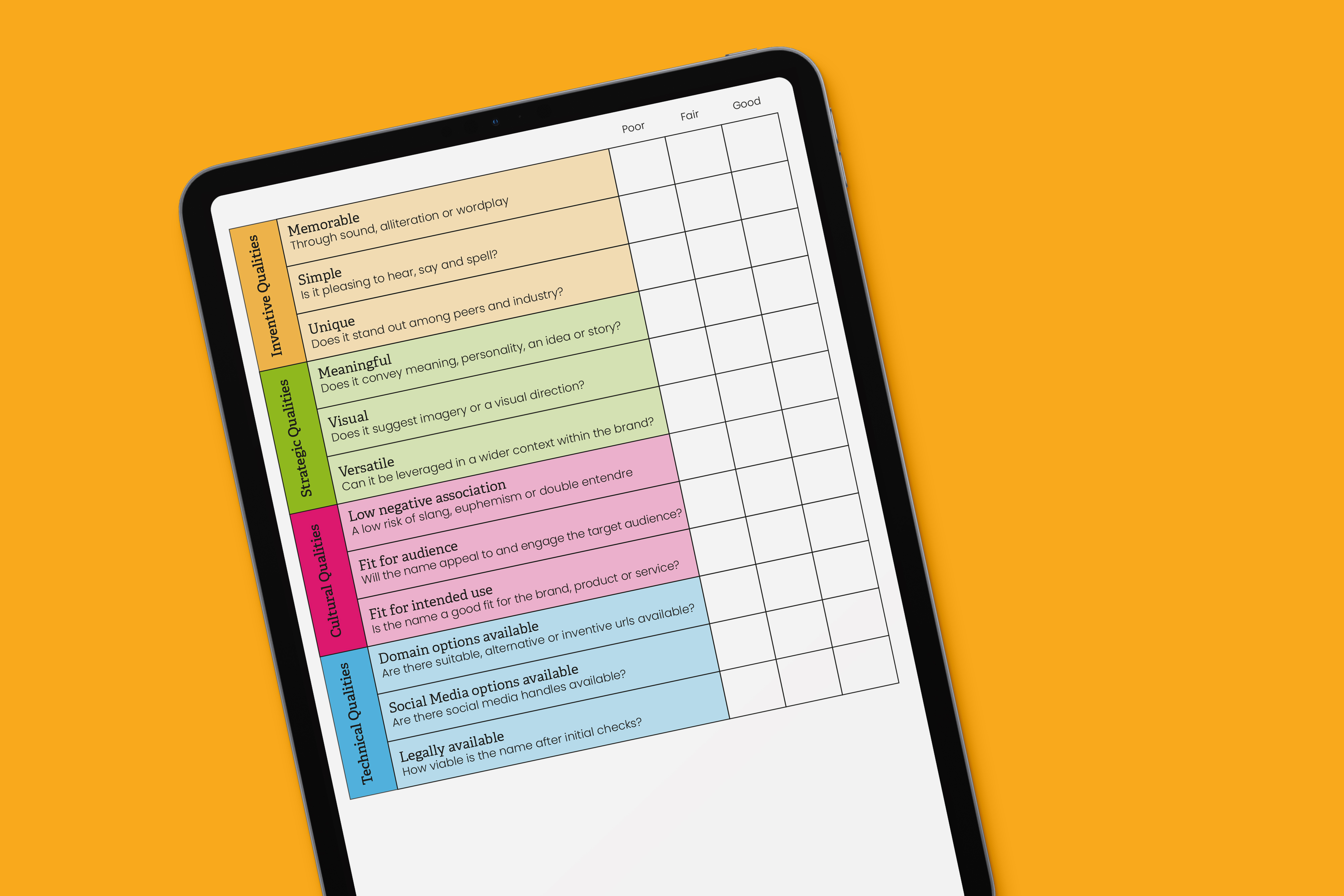
Section Three: Cultural Qualities
7. Low Negative Association: Is there a risk of slang or double entendre? Check Urban Dictionary. You don't want to be the next Mazda Laputa or Mitsubishi Pajero , which have some unfortunate slang translations in Spanish… Google it if you must…
8. Fit for Audience: Will it engage the target demographic? Ensure you aren't using dated language that ages your brand immediately.
9. Fit for Intended Use: Is it appropriate for the service? Give yourself another sense check here. Humour works for The Boring Company (tunnelling) or What the Cluck (chicken substitute), but maybe not for a funeral director (even if you are aiming for distinction!)
Remember, a good name should start with being memorable, easy to say and spell, and it should stand out among your peers. Aim for distinction.
Section Four: Technical Qualities (Perform these LAST)
10. Domain Options: Are there suitable URLs available (remember, not just .com)?.
11. Social Media Options: Are handles available? Use tools like Namecheckrr to see your options.
Now present your shortlisted names to your colleagues, before choosing three or four for legal checks (Step 12)
10. Conclusion: Presentation and Final Selection
You have filtered your list down to around ten strong contenders. Now you need to choose.
Consistent Formatting
When presenting shortlisted names to partners or stakeholders, present them in the same font and format (e.g., as a simple word on a screen or on a business card mock-up) to avoid design bias. Avoid dressing up the brand name suggestions with any graphic design, specific font choice or colour. You want people to judge the word, not design.
The Right Questions
Don't ask "What do you not like?" instead, ask "Which names do you like and why?". Remind everyone of the original brief and the concepts you agreed upon. Avoid asking for opinions from outsiders early on, as they are not privy to the naming brief requirements.
Now you’ve presented your naming shortlist, and whittled that down to three or four names, we go to the last step:
When presenting names, avoid dressing up the brand name suggestions with any graphic design, specific font choice or colour. You want people to judge the word, not design.
12. Legally Available: How viable is the name after preliminary trademark checks?.
Always seek professional legal assistance for final trademark and legal checks. Your legal team will advise on how ‘safe’ it would be to proceed, depending on which trademark classes you operate under. You do not want to end up like the World Wrestling Federation (WWF), who lost a battle with the World Wildlife Fund and had to rebrand to WWE.
Final Thoughts
A strong name isn’t just a label. It is a strategic asset. It shapes perception from the very first moment and gives every future brand decision more impact.
By following this structured process—briefing, generating, evaluating, and screening—you move away from subjective "I like it" conversations and towards a strategic decision that will serve your startup for years to come.
Your brand will evolve and change over time, but your brand name will arrive first, and outlast everything else. Make it count.
Ready for your brand to be noticed, admired, and remembered?
Developing a brand name is a journey. It requires a balance of strategy, creativity, and objective evaluation to arrive at a name that will outlast your logo and define your business for years to come.
Whether you want to go it alone, need a sounding board, or want a professional to handle the entire process, I have three ways to help you get the name your startup deserves.
1. The DIY Route: Download the Free Guide
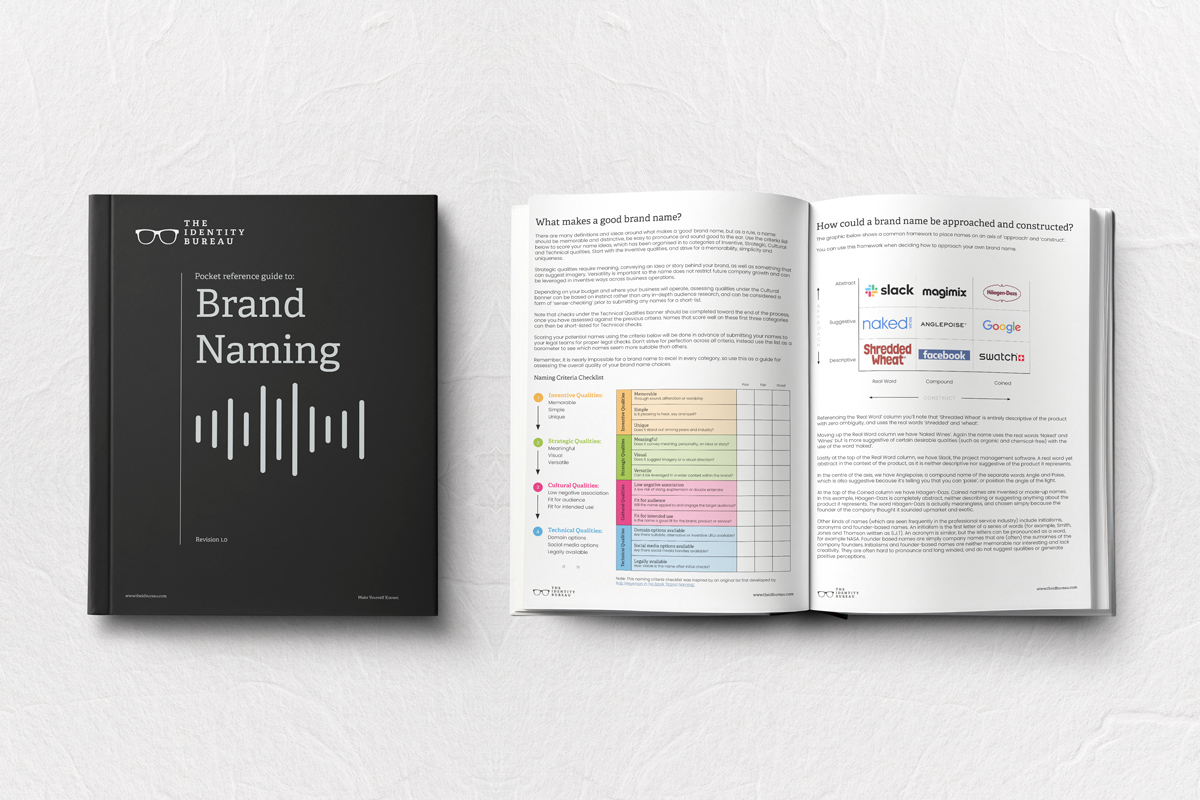
If you are ready to tackle this process yourself but want a handy reference to keep you on track, download my Pocket Guide to Brand Naming. It covers the steps in this article, including the naming brief and the 12-point criteria checklist, helping you consider how you want your future brand to be understood.
2. The "Done With You" Route: Book a One-Hour Workshop (Currently on offer at £99)
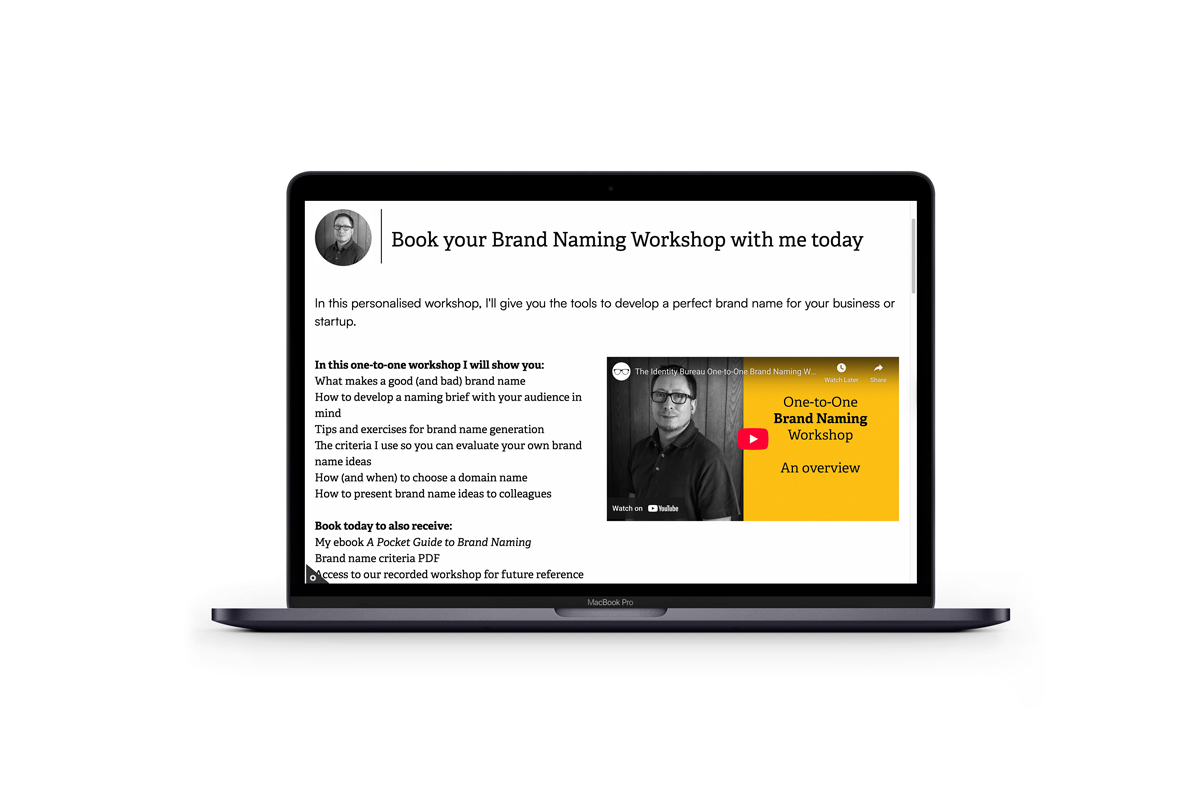
If you are struggling to write your brief, or simply want an expert opinion on your ideas, book a one-to-one naming workshop. In this one-hour session, I will help you formulate your naming brief, discuss what makes a good (and bad) name, and advise you on how to choose a domain name.
It is a focused, cost-effective way to get professional clarity before you commit.
3. The "Done For You" Route: The Brand Naming Service
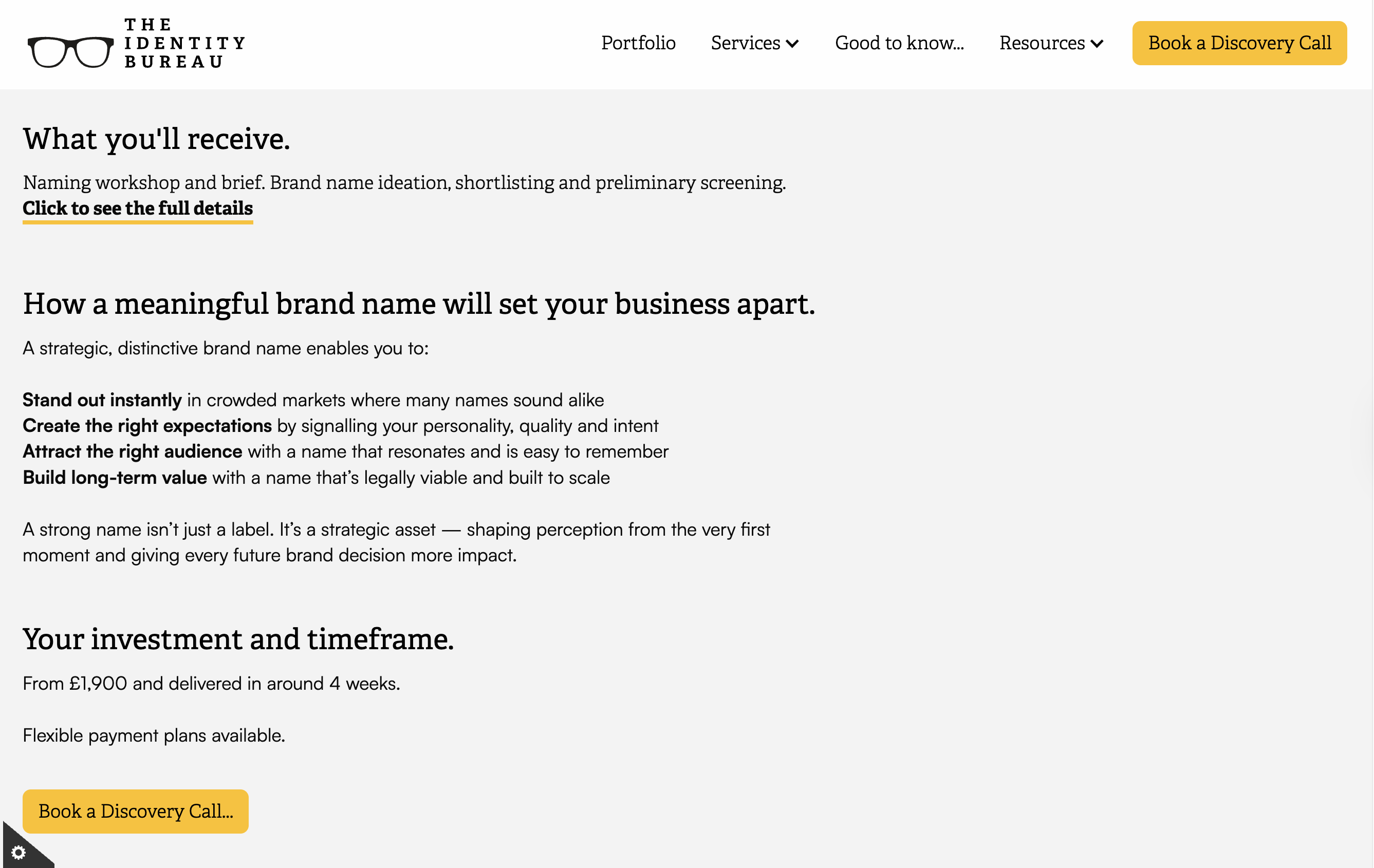
If you want a fully structured process that delivers distinctive, meaningful, and legally viable names, let me do the heavy lifting. My Brand Naming Service takes you from the initial workshop and brief creation through to ideation, shortlisting, and preliminary legal screening with my legal partners.
We will work together to ensure you finish with a name that fits your brand and your future, giving you the confidence to stand out in a crowded market.

Written by:
File under:
Added on:
Ben is a branding and naming consultant. As the owner of The Identity Bureau he regularly blogs on the topic of branding, naming and identity design. Among other things, he likes horror films, mountain biking and collecting vintage movie posters.